About Us
 Meet Our Team
 Our Facilities
 Testimonials
 Videos
 Newsroom
 Scholarship
 FAQ
FAQ Blog
Blog
 Newport Beach

 Long Beach


 Meth Rehab
 Outpatient Rehab
 IOP Rehab
 Virtual IOP
 PHP Rehab
 LGBTQ Friendly Rehab
 Device Friendly Rehab
 Pet Friendly Rehab
 Couples Drug Rehab
 Reiki Therapy
 Holistic Addiction Therapy
 Addiction Therapy
 Group Addiction Therapy
 EMDR Therapy
 CBT Therapy
 Mood Disorder Treatment
 Panic Disorders/Drinking Problems Treatment
 Addictive Personality Disorder Treatment
 Hyperfixation Treatments
 Hyper Independence Treatment
 Admissions Process
 Check My Insurance
 Rehab Insurance Coverage
 Financing Options
 What To Bring to Rehab
 Cigna
Cigna


A drug taper is one effective way to wean off drugs or medications after developing physical dependence on illicit drugs, prescription medications, or alcohol.
Physical dependence can arise from the use and misuse of illicit narcotics, prescription medications, and alcohol. Dependence includes both tolerance—where higher doses are needed to deliver the initial effects—and withdrawal, which causes negative physical and emotional symptoms if the drug is abruptly discontinued or its dosage is significantly reduced. Tolerance and withdrawal are both diagnostic criteria for addiction.
A common approach to address withdrawal symptoms, including opioid withdrawal symptoms, involves tapering strategies. To ensure safe and effective withdrawal management, ASAM (American Association of Addiction Medicine), a prominent organization of healthcare professionals in the field of addiction, has established guidelines that outline best practices for tapering various substances.
This guide will cover the following topics and common questions:
- What is a “drug taper?”
- What to expect when weaning off medication.
- What are the benefits of tapering medication?
- Weaning off medication, alcohol, or illicit drugs in Southern California – connect with evidence-based treatment near you.
What Is Drug Tapering?
When someone becomes physically dependent on a drug, their body and brain chemistry can undergo significant changes. This often triggers the manifestation of withdrawal symptoms upon discontinuation, especially in cases of prolonged or heavy consumption. Such symptoms can range from uncomfortable to life-threatening—especially in scenarios involving opioids, benzodiazepines, or alcohol.
To mitigate severe withdrawal symptoms and facilitate lasting recovery, many rehab centers have used drug tapering in their treatment approaches. Tapering involves gradually reducing the dosage of an addictive substance over time to help someone wean off medication, drugs, or alcohol. This method is particularly beneficial for individuals who have used substances to manage chronic pain, as sudden discontinuation can lead to intense withdrawal symptoms.
However, under the supervision of experienced medical professionals, tapering allows the body to slowly adapt to the absence of the addictive substance, which alleviates withdrawal symptoms and reduces the risk of complications.
Drug tapering has become a widely accepted practice within the rehabilitation community. To ensure consistency, ASAM offers clinicians and physicians guidelines to taper patients off substances in the safest and most efficient manner. Given the risks associated with withdrawal, individuals tapering off alcohol or drugs should only do so under professional guidance to avoid relapse or adverse effects.
Drug tapering and withdrawal management are distinct from comprehensive drug or alcohol treatment. Tapering is most effective when combined with clinical care, such as individual and group therapy.

The Drug Tapering Process
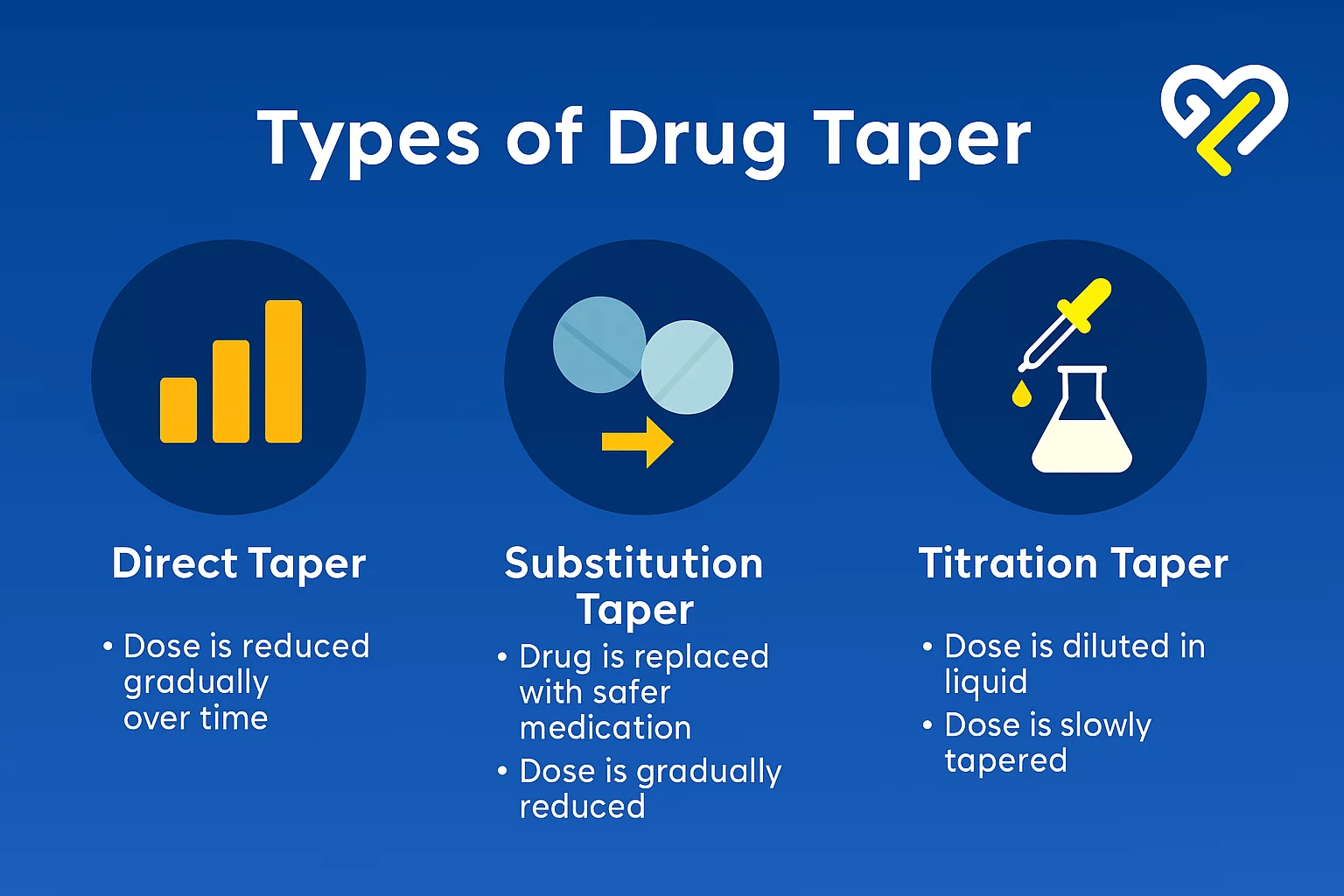
During treatment, three primary tapering methods are used: direct tapering, substitution tapering, and titration tapering. The choice of method depends on the person’s medical history and current condition.
- Direct tapering: This method involves gradually reducing the drug dosage an individual takes. It is effective when someone has been using high doses of a long-acting substance (ex, diazepam, aka Valium) or one that doesn’t accumulate in the bloodstream. Weekly decreases in dosage help the person discontinue use without experiencing severe withdrawal symptoms.
- Substitution tapering: Used for illicit, short-acting, or low-dose substance (ex, heroin) addictions, substitution tapering replaces the addictive substance with a similar but more easily tapered one. Controlled amounts of medication with lower abuse potential are administered, allowing precise and gradual dosage reduction.
- Titration tapering: This method involves dissolving a small amount of a low-dose drug in water to further dilute it. Titration tapering is rarely used in clinical settings due to the risks involved. It may lead to unintentional overdose or ineffective tapering, especially with drugs that are not water-soluble. Without proper medical equipment, measuring specific doses in diluted solutions is challenging and potentially dangerous. Titration tapering should never be attempted without professional supervision due to its inherent risks.
Variability in the tapering process is influenced by the specific drug, the individual, and the treating physician. This is a general framework for the tapering process:
- Initial administration: The physician provides a minimal dose to prevent significant withdrawal symptoms. Starting doses differ based on medications. After administering the initial dose, recovery is monitored and adjusted if notable withdrawal symptoms emerge. Once the starting dose is set, the tapering process begins gradually.
- Initial dosage reduction: Typically, the initial reduction is about 10% of the starting medication dose. This percentage may be adjusted based on the individual’s response and withdrawal symptoms. Usually, this reduction occurs within one to two weeks.
- Subsequent reductions: Subsequent dosage reductions are spaced 1 to 2 weeks apart, with the guideline being a 10% reduction from the starting dose.
- Further reductions: As the dosage approaches 80% to 90% less than the initial dose, smaller reductions like 5% may be necessary to prevent significant withdrawal symptoms.
- Complete discontinuation: When the patient is down to about 5% of the initial dose, discontinuation from the drug may be practical.
Is Drug Tapering the Best Method for Withdrawal?
While drug tapering is a widely used and effective method for managing withdrawal symptoms, it may not always be the best approach for every individual…
Common Drug Withdrawal Symptoms
When individuals discontinue or taper off of an addictive substance, they will still likely experience withdrawal symptoms…
- Trouble sleeping
- Headaches
- High blood pressure
- Abdominal cramps
- Mood changes
Drug Withdrawal Timeline
Early Stage: First 24 Hours
For most, symptoms will begin within the first 24 hours…
Peak Stage: Days 2–7
Typically, by day 2, withdrawal peaks…
Final Stage: Week 2 and Beyond
By week 2, acute symptoms generally fade…
Drug Taper | FAQs
What Is A Drug Taper?
A drug taper is a gradual reduction in the dosage…
Are There Tapering Medications For Drug Withdrawal?
Yes, tapering medications like methadone and Suboxone…
What Is The Best Way To Wean Off Drugs?
The best way to wean off drugs is often through…
Can Rehab Help You Wean Off Medication?
Yes, rehab programs can provide medical support…
Get Effective Treatment For Drug Withdrawal At Gratitude Lodge
At Gratitude Lodge, located in Southern California…
Sources
- https://www.ncbi.nlm.nih.gov/books/NBK310652/